The universally accepted function of religion is to protect society from social and moral degradation and to guide its destiny in such a way as to achieve the greatest good of the largest number of people. Whenever the universal human values are on the decline, religion is thought to have failed in doing its duty of guiding the Society. The more a religion tends to unite people and to strive for the service of humanity, the nearer it is to its aim. The world has seen many religions at different times. Sikhism is one of them and perhaps the latest.
Sikhism is an endeavour to create a union of all those who love God and serve humanity.

A devout Sikh respects the adherents of all other faiths irrespective of the differences of creed and ways of worship. The example was set by Guru Nanak who made friend with an untouchable (low caste) Muslim named Mardana and kept his friendship till death without even once asking him to renounce Islam and to accept the Guru's religion.
The same is reflected in the Sikh Holy Scripture, Sri Guru Granth Sahib, regarded as the Living (Shabad or Word) Guru, of the Sikhs. The universal teachings of Sri Guru Granth Sahib is for the benefit of humankind. Side by side with the hymns of Sikh Gurus are recorded the hymns of a king, a Brahman, a barber, a Muslim and an untouchable (so-called shudra) all professing different religions. Its message, as the Guru himself put it: "is for all the four castes" *and the whole of humanity.
Guru Gobind Singh, the tenth Guru of the Sikhs, had a number of Muslims in his army fighting against the tyrannical Mughal empire. Last but not least the foundation stone of the Holiest shrine of the Sikhs, Sri Harimandar Sahib (also known as the Golden Temple) was laid by a Muslim, Sayeen Mian Mir.
For the Sikh the whole humanity is a united family, a brotherhood under one God. Duncan Greenless has summed up Sikhism as "the religion taught through Guru Nanak in the forms of the Ten Gurus and now through the Guru Granth Sahib and the whole community of disciples. It is a practical way of life, leading man straight to his goal, and does not involve itself in verbose theorising."
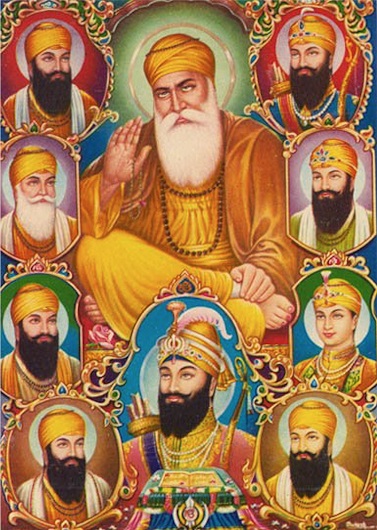
- Gurus
- Guru Nanak Dev Ji
- Guru Angad Dev Ji
- Guru Amar Das Ji
- Guru Ram Das Ji
- Guru Arjan Dev Ji
- Guru Hargobind Sahib Ji
- Guru Har Rai Ji
- Guru Har Krishan Ji
- Guru Tegh Bahadur Ji
- Guru Gobind Singh Ji
- Principles
- Kirat Karna - Honest labour
- Wand Ke Chhakna - Sharing with others
- Parcha Shabad Ka - Understanding Gurbani
- Nam Japna - Meditation or contemplation on the Name of God
- Sarbat Da Bhala - Well-Being of Human Race
- Nishkam Seva Sambhal - Selfless service
- Ishnan and Darshan Ishnan - Purity of mind and body
- Sacha Achar - Keeping good moral character
- To be always in Charhdi Kala - Optimism-exalted spirit
- Universal Brotherhood
- Beliefs
- Code of Conduct
- Philosophy
- Prayers
- Ceremonies
- Institutions
- Amrit Ceremony
- Educational Institutions of the Sikhs
- Family
- Langar
- Marriage
- Martyrdom
- Pangat
- Sangat
- Seva
- Takhts
- Sri Akal Takht Sahib, Amritsar (Punjab)
- Takht Sri Harmandar Sahib, Patna (Bihar)
- Takht Sri Kesgarh Sahib, Anandpur (Punjab)
- Takht Sri Hazur Sahib, Nanded (Maharashtra)
- Takht Sri Damdama Sahib, Talwandi Sabo (Punjab)
- The Sikh Festival Calendar
- An A-Z Sikhism Glossary
- General Questions on Sikhism
- God and His Universe
- Principles
- The Sikh History
- Sacred Literature
- Worship, Ceremonies and the Future
- Sikhism & Modern Problems
DISCIPLINE OF A SIKH
Sikhism has always been very clear about the discipline required of a Sikh. In fact, Guru Ram Das, the fourth Guru Nanak, laid down an aspect of the discipline required for a Sikh's everyday life.
"Let him, who calls himself a Sikh of the True Guru,
Rise early and meditate on God;
Let hint exert himself in the morning and bathe in the tank of Nectar,
Let him repeat God's Name;
under the Guru's instruction;
Thus shall his sins and errors-be erased.
Let him at sunrise sing the Guru's hymns;
Sitting or standing, he should meditate on God's Name.
The Disciple, who at every breath, meditates on God;
will please the Guru's heart.
He alone takes the Guru's instruction;
who is by the Lord's mercy so guided.
The slave Nanak seeks the dust of the feet of him,
Who himself repeats Gods name, and leads others to do so."
(Guru Granth Sahib, pg 305-306)
Meditation on the Name of God (Naam Simran) was and is the most important thing for Sikhs living by a discipline prescribed clearly by the Guru.
The Sikh Rehat Maryada
As per the constitution The Sikh Missionary Society follow the the code of conduct as laid down by the REHAT MARYADA approved and published by Shromani Gurdwara Prabandhak Committee, Amritsar and Sri Akal Takhat Sahib.
To receive a FREE copy of the Rehat Maryada from the Sikh Missionary Society please send a stamped self addressed envelope ( Sizes 22cm wide and 15 cm height.) to the following address
Free Rehat Maryada
Sikh Missionary Society
10 Featherstone Road,
Southall,
Middlesex
UB2 5AA.
England, UK
The Rehat Maryada is also available to read online in the Publications section.
Most of the literature on Sikhism, Sikh History, tradition and culture is supplied free of charge to anyone who is interested in Sikhism.